○関数の極限の定義
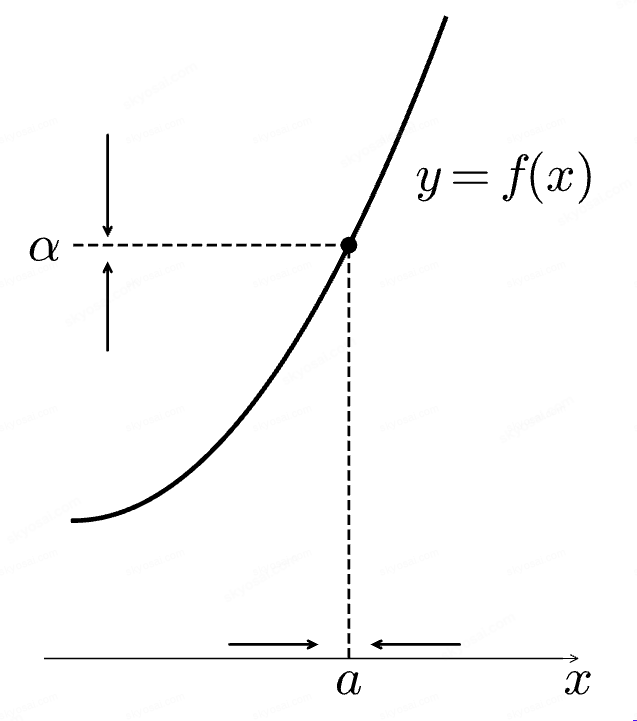
この表で,\( \displaystyle f(x) \) は一変数の実数値関数,\( \displaystyle a, \alpha \) は実数とする.
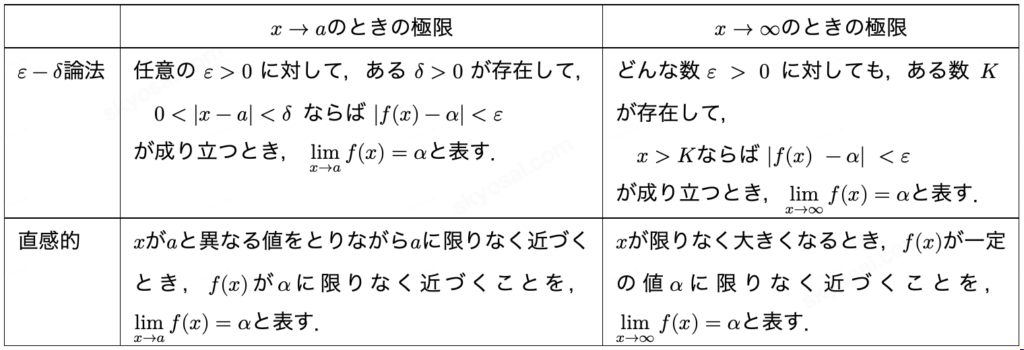
※「\( \displaystyle \lim_{x \to a} f(x) = \alpha \)」のことを,「\( \displaystyle x \to a \) のとき \( \displaystyle f(x) \to \alpha \)」,「\( \displaystyle x \to a \) のとき \( \displaystyle f(x) \) は \( \displaystyle \alpha \) に収束する」「\( \displaystyle x \to a \) のとき \( \displaystyle f(x) \) の極限値は \( \displaystyle \alpha \)」などとも表現する(\( \displaystyle x \to \pm \infty \) でも同様).
※ \( \displaystyle x \to a \) のとき \( \displaystyle f(x) \) がどの値にも収束しないとき,\( \displaystyle f(x) \) は発散するという(\( \displaystyle x \to \pm \infty \) でも同様).
※以下では,特に断りがない限り,直感的な定義で進める.
○片側極限
・\( \displaystyle x \) が \( \displaystyle a \) より大きい(小さい)値をとりながら \( \displaystyle a \) に限りなく近づくとき,\( \displaystyle f(x) \) が \( \displaystyle \alpha \) に限りなく近づくことを
\( \displaystyle \ \ \ \ \ \ \lim_{x \to a+0} f(x) = \alpha \ \left(\lim_{x \to a-0} f(x) = \alpha\right) \) と表す.
・\( \displaystyle \lim_{x \to a+0} f(x), \lim_{x \to a-0} f(x) \) がともに存在して,\( \displaystyle \lim_{x \to a+0} f(x) = \lim_{x \to a-0} f(x) = \alpha \) のとき,\( \displaystyle \lim_{x \to a} f(x) = \alpha \) が成り立つ.
※ \( \displaystyle \lim_{x \to a+0} f(x) \) を右側極限,\( \displaystyle \lim_{x \to a-0} f(x) \) を左側極限という.
※とくに,\( \displaystyle x \to 0+0, x \to 0-0 \) は単に \( \displaystyle x \to +0, x \to -0 \) で表す.
○関数の極限の、典型的な処理方法
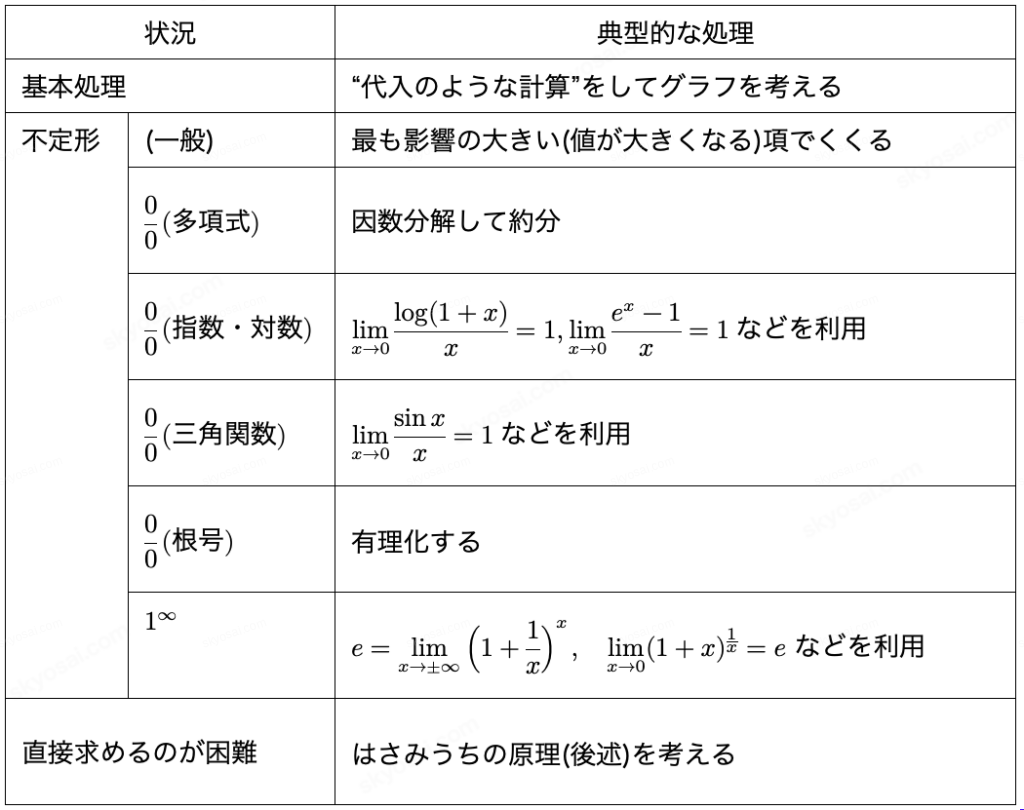
※本資料で特に断りがない場合,微分積分の話をするさいの \( \displaystyle \log X \) は,自然対数(底がネイピア数,\( \displaystyle e=2.7128\cdots \))を表すものとする.
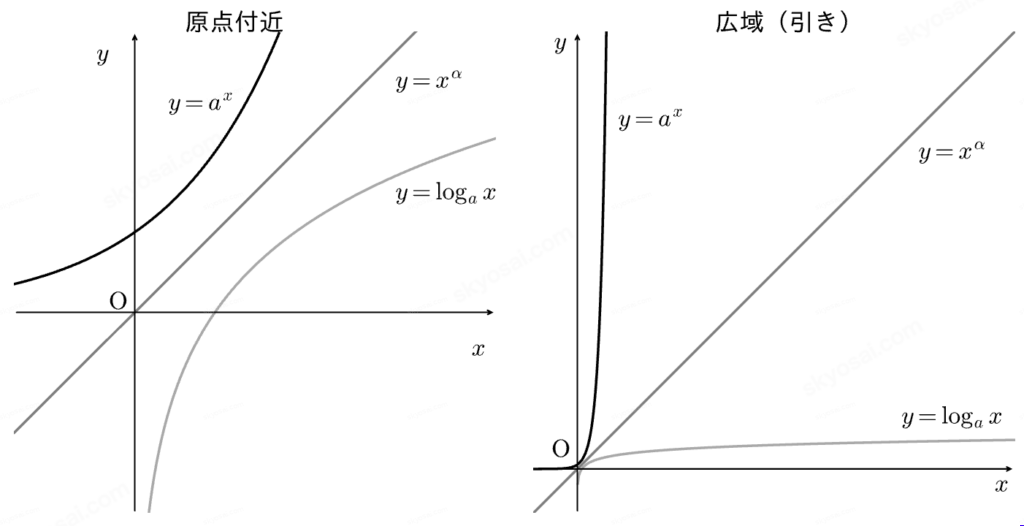
○関数の増加(対数関数、多項式の関数、指数関数)
\( \displaystyle a, \alpha \) を \( \displaystyle a \gt 1, \alpha \gt 0 \) を満たす実数とする.
(1) \( \displaystyle \lim_{x \to \infty} \frac{\log_a x}{x^\alpha} = 0 \) (2) \( \displaystyle \lim_{x \to \infty} \frac{x^\alpha}{a^x} = 0 \)
○はさみうちの原理など
\( \displaystyle \alpha, \beta \) を実数,\( \displaystyle f(x), g(x), h(x) \) を \( \displaystyle x=a \) の近くで \( \displaystyle f(x) \le g(x) \le h(x) \) を満たす関数とする.
(1)\( \displaystyle \lim_{x \to a} f(x) = \lim_{x \to a} h(x) = \alpha \Rightarrow \lim_{x \to a} g(x) = \alpha \)
(2) \( \displaystyle \lim_{x \to a} f(x) = \infty \Rightarrow \lim_{x \to a} g(x) = \infty \)
(3) \( \displaystyle \lim_{x \to a} g(x) = -\infty \Rightarrow \lim_{x \to a} f(x) = -\infty \)
※(1)をはさみうちの原理という.(2)(3)は追い出しの原理と呼ばれることがある.
(例,山口県)等式 \( \displaystyle \lim_{x \to 2} \frac{\sqrt{x+a}-b}{x-2} = \frac{1}{6} \) が成り立つように,定数 \( \displaystyle a, b \) の値を定める.
(例,京都市)
極限値\( \displaystyle \lim_{x \to 0} \frac{\sin x – \tan x}{x^3} \)を求めよ.
| \( \displaystyle \frac{\sin x – \tan x}{x^3} = \frac{\sin x ( \cos x – 1 )}{x^3 \cdot \cos x} \) \( \displaystyle \ \ \ \ \ \ \ \ \ \ \ \ \ \ \ \ \ \ \ \ \ = \frac{\sin x}{x} \cdot ( -1 ) \left( \frac{1 – \cos x}{x^2} \right) \cdot \frac{1}{\cos x} \ \ \text{…①} \) ここで, \( \displaystyle \ \ \ \ \frac{1 – \cos x}{x^2} = \frac{( 1 – \cos x )( 1 + \cos x )}{x^2 ( 1 + \cos x )} \) \( \displaystyle \ \ \ \ \ \ \ \ \ \ \ \ \ \ \ \ \ \ \ \ = \frac{\sin^2 x}{x^2} \cdot \frac{1}{1 + \cos x} \to \frac{1}{2} \ ( x \to 0 ) \) であるから,\( \displaystyle x \to 0 \) のとき, \( \displaystyle \ \ \ \ \text{①} \to 1 \cdot ( -1 ) \cdot \frac{1}{2} \cdot 1 = – \frac{1}{2} \ \ \text{(答)} \) |
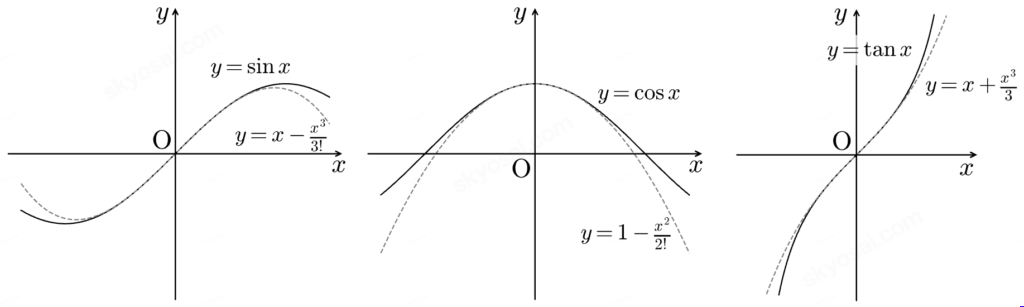
※ \( \displaystyle x = 0 \) の近くで,\( \displaystyle \sin x ≒ x – \frac{x^3}{3!} \),\( \displaystyle \cos x ≒ 1 – \frac{x^2}{2!} \),\( \displaystyle \tan x ≒ x + \frac{x^3}{3} \) である.
(例,三重県)
極限値\( \displaystyle \lim_{x \to 0} \frac{1-e^{x^3}}{x^2 \cdot \log (1+3x)} \)を求めよ.
\( \displaystyle \frac{1 – e^{x^3}}{x^2 \cdot \log ( 1 + 3x )} = \left( – \frac{e^{x^3} – 1}{x^3} \right) \left( \frac{3x}{\log ( 1 + 3x )} \right) \cdot \frac{1}{3} \to -1 \cdot 1 \cdot \frac{1}{3} \ ( x \to 0 ) \)
により,\( \displaystyle \lim_{x \to 0} \frac{1 – e^{x^3}}{x^2 \cdot \log ( 1 + 3x )} = – \frac{1}{3} \ \ \text{(答)} \)
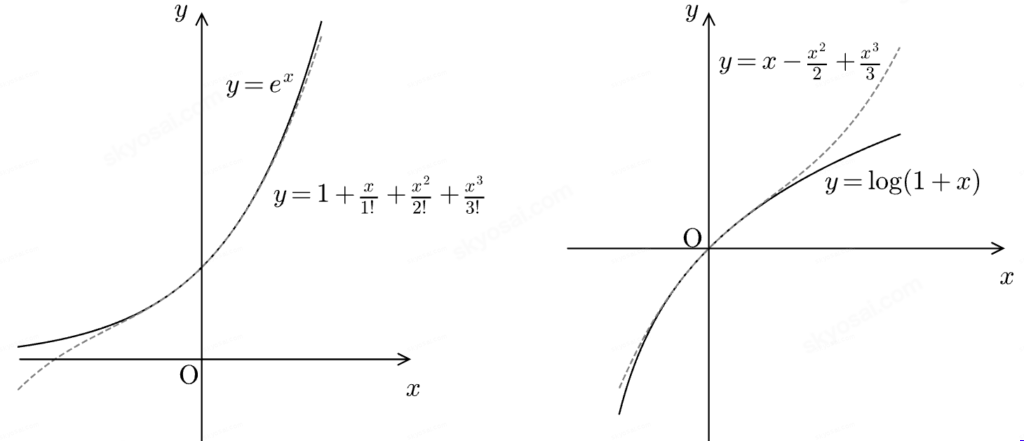
※ \( \displaystyle x = 0 \) の近くで,\( \displaystyle e^x ≒ 1 + \frac{x}{1!} + \frac{x^2}{2!} + \frac{x^3}{3!} \),\( \displaystyle \log ( 1 + x ) ≒ x – \frac{x^2}{2} + \frac{x^3}{3} \) である.
この記事は役に立ちましたか?
間違い/不具合かな?
と思ったらこちらへ