○極形式と複素数の積・商(ほぼ再掲)
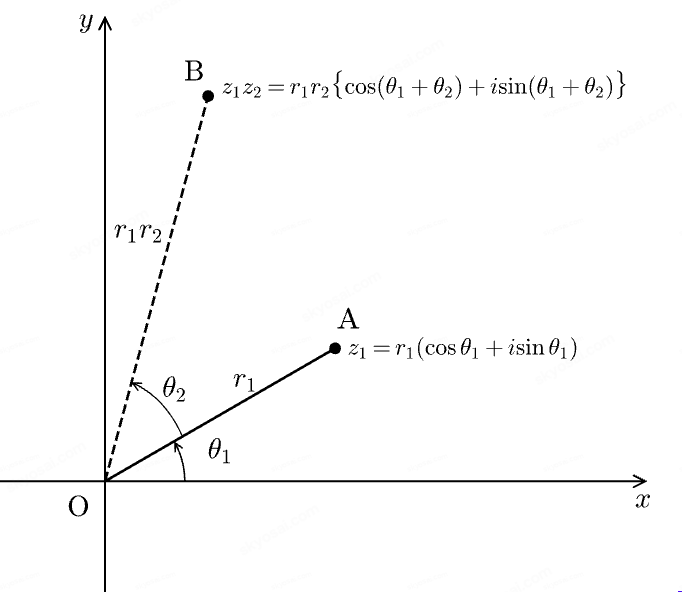
\( \displaystyle z_1=r_1 (\cos \theta_1 + i \sin \theta_1) \),\( \displaystyle z_2=r_2 (\cos \theta_2 + i \sin \theta_2) \)を極形式とする.
\( \displaystyle \ \ \ \ \ z_1 z_2=\{r_1 (\cos \theta_1 + i \sin \theta_1)\}\{r_2 (\cos \theta_2 + i \sin \theta_2)\}=r_1 r_2 \{\cos (\theta_1+\theta_2)+i \sin (\theta_1+\theta_2)\} \)
\( \displaystyle \to z_1 z_2 \)は,\( \displaystyle z_1 \)を原点中心に\( \displaystyle \theta_2 \)回転し,\( \displaystyle r_2 \)倍したもの.
○複素数平面上の図形の処理
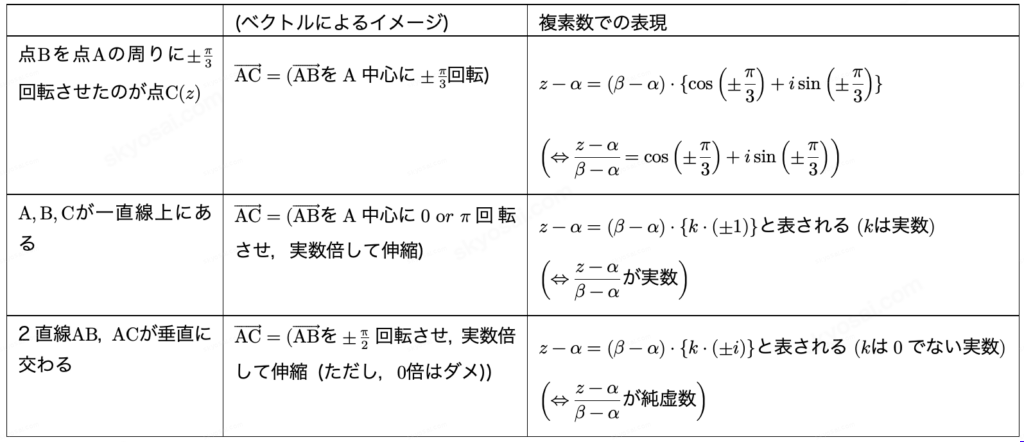
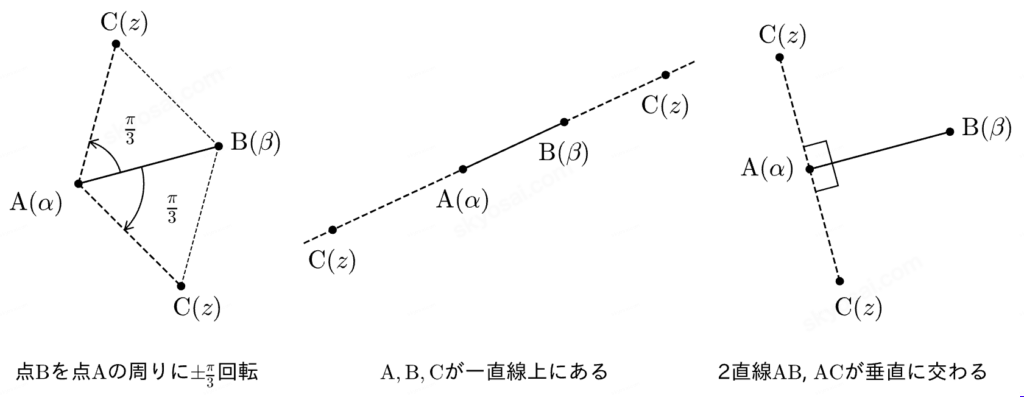
(例)複素数平面上の\( \displaystyle 3 \)点\( \displaystyle \mathrm{A}(\alpha), \mathrm{B}(\beta), \mathrm{C}(z) \ \ (\text{ただし,}\alpha \neq \beta) \)について,
(例,鳥取県) \( \displaystyle 0 \)でない複素数\( \displaystyle \alpha, \beta \)が\( \displaystyle |\alpha-\beta|=3, \alpha^2-2\alpha\beta+4\beta^2=0 \)を満たしているとき,\( \displaystyle \frac{\alpha}{\beta} \)の値求め,
さらに,複素数平面において\( \displaystyle 3 \)点\( \displaystyle \mathrm{O}(0), \mathrm{A}(\alpha), \mathrm{B}(\beta) \)のつくる三角形の面積を求める.
方程式を解くとき,極形式で\( \displaystyle r \)と\( \displaystyle \theta \)を分けて求めるのが有効な場合がある.
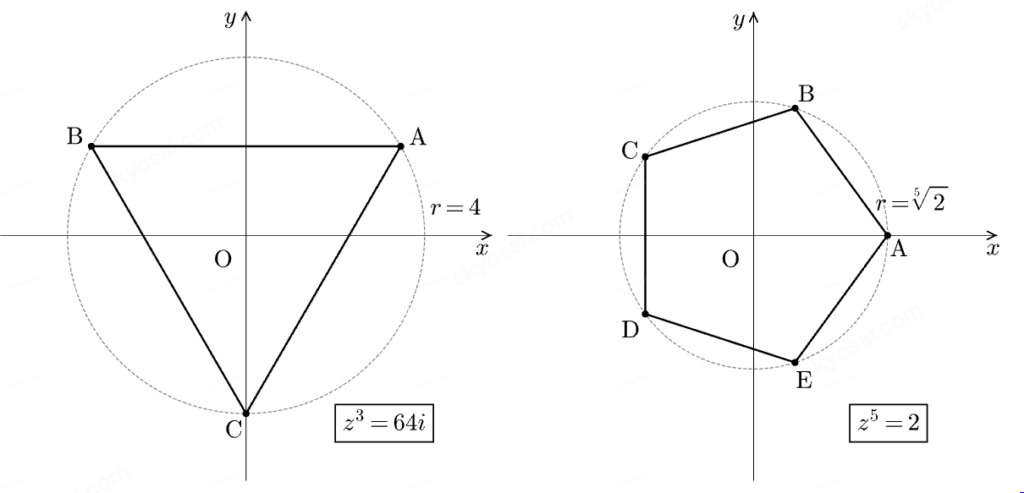
(例) 方程式\( \displaystyle z^3=64i \)を解け.
| \( \displaystyle z^3=64i \Rightarrow |z^3|=|64i| \ \ \ \ \textcolor{red}{\leftarrow \text{いったん} r \text{から求める}}\) \( \displaystyle \ \ \ \ \ \ \ \ \ \ \ \ \ \ \ \ \ \ \Leftrightarrow |z|^3=64 \) \( \displaystyle \ \ \ \ \ \ \ \ \ \ \ \ \ \ \ \ \ \ \Leftrightarrow |z|=4 \ \ \ (\because |z| \geqq 0) \) \( \displaystyle z=4(\cos \theta + i \sin \theta) \ \ (0 \leqq \theta \lt 2\pi) \)とおくと, \( \displaystyle \ \ \ \ \ z^3=64i \) \( \displaystyle \ \ \ \ \ \Leftrightarrow 64(\cos 3\theta + i \sin 3\theta)=64i \) \( \displaystyle \ \ \ \ \ \Leftrightarrow \cos 3\theta + i \sin 3\theta=i \) \( \displaystyle 0 \leqq 3\theta \lt 6\pi \)であるから, \( \displaystyle \ \ \ \ \ 3\theta=\frac{\pi}{2}, \frac{5}{2}\pi, \frac{9}{2}\pi \) よって,\( \displaystyle \theta=\frac{\pi}{6}, \frac{5}{6}\pi, \frac{3}{2}\pi \)であるから, \( \displaystyle \ \ \ \ \ z=4\left(\cos \frac{\pi}{6} + i \sin \frac{\pi}{6}\right), 4\left(\cos \frac{5}{6}\pi + i \sin \frac{5}{6}\pi\right), 4\left(\cos \frac{3}{2}\pi + i \sin \frac{3}{2}\pi\right) \) \( \displaystyle \ \ \ \ \ \ \ =2(\sqrt{3}+i), 2(-\sqrt{3}+i), -4i \) (答) |
※上の計算を一般化すると, \( \displaystyle 0 \)でない複素数 \( \displaystyle w \) の \( \displaystyle n \) 乗根(\( \displaystyle z^n=w \)の解)は,すべて絶対値が等しく,偏角が\( \displaystyle \frac{2\pi}{n} \) ずつ等間隔になることがわかる.複素数平面上においては,原点を中心とする円に内接する正 \( \displaystyle n \) 角形の頂点に対応する.
○極座標
・平面上に点\( \displaystyle \mathrm{O} \)と半直線\( \displaystyle \mathrm{OX} \)を定める.\( \displaystyle r=\mathrm{OP} \)と\( \displaystyle \mathrm{OX} \)を始線とする動径\( \displaystyle \mathrm{OP} \)の表す一般角\( \displaystyle \theta \)の組\( \displaystyle (r, \theta) \)を点 \( \displaystyle \mathrm{P} \)の極座標という.このとき,点\( \displaystyle \mathrm{O} \)を極,\( \displaystyle \theta \)を点\( \displaystyle \mathrm{P} \)の偏角という.
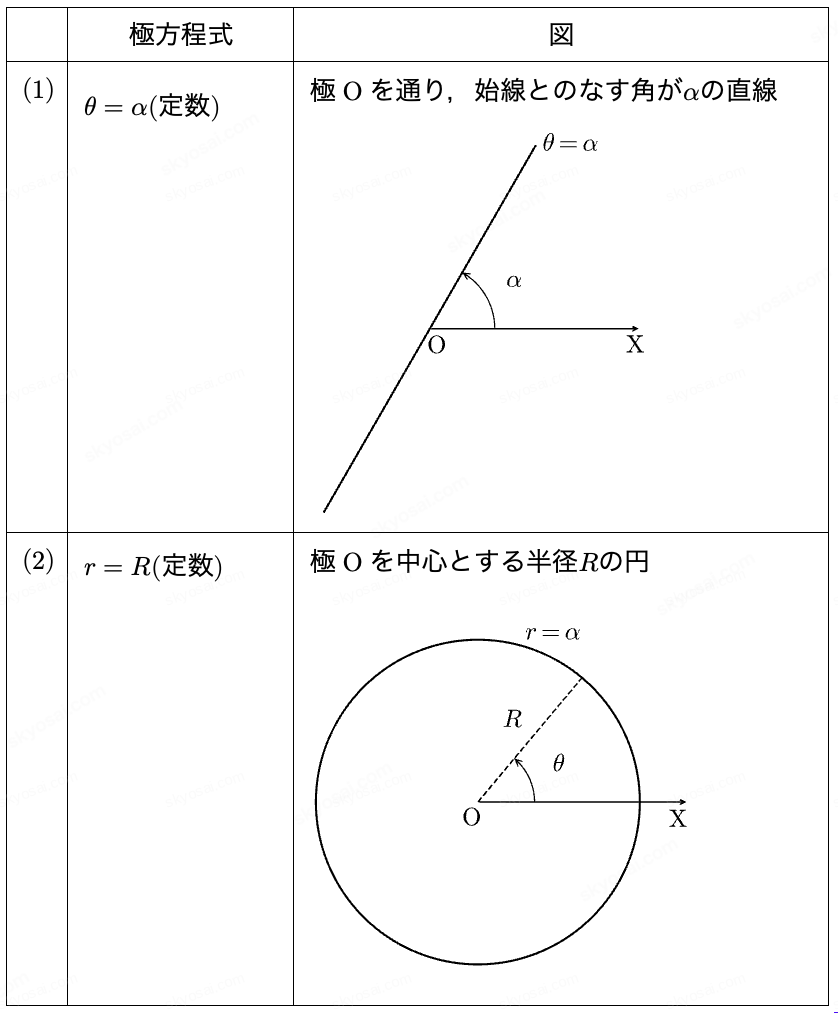
・ある曲線が極座標\( \displaystyle (r, \theta) \)に関する方程式で表されるとき,その方程式を曲線の極方程式という.
・ \( \displaystyle r \lt 0 \)のとき,点\( \displaystyle (r, \theta) \)を点\( \displaystyle (-r, \theta+\pi) \)で定める.
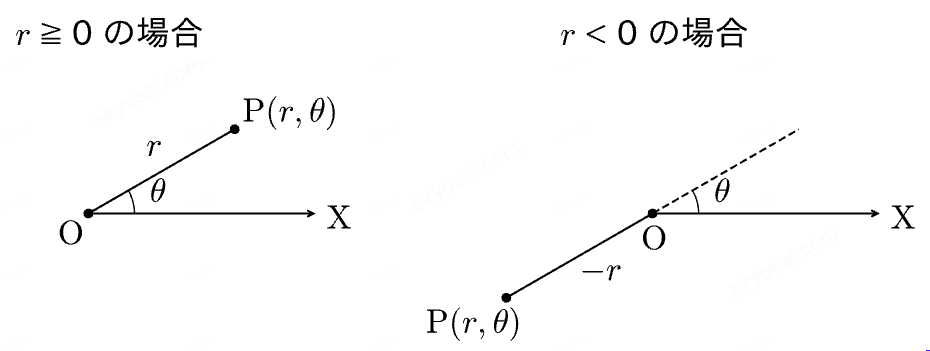
※\( \displaystyle r, \theta \)に制限がない場合,極座標による点の表し方は一意的ではない.
※「\( \displaystyle r \)について,極座標を考えるだけの場合は\( \displaystyle r \geqq 0 \)で考え,極方程式を考える際は負の範囲も認める」という立場もあるが,ここでは区別せずに定義している.
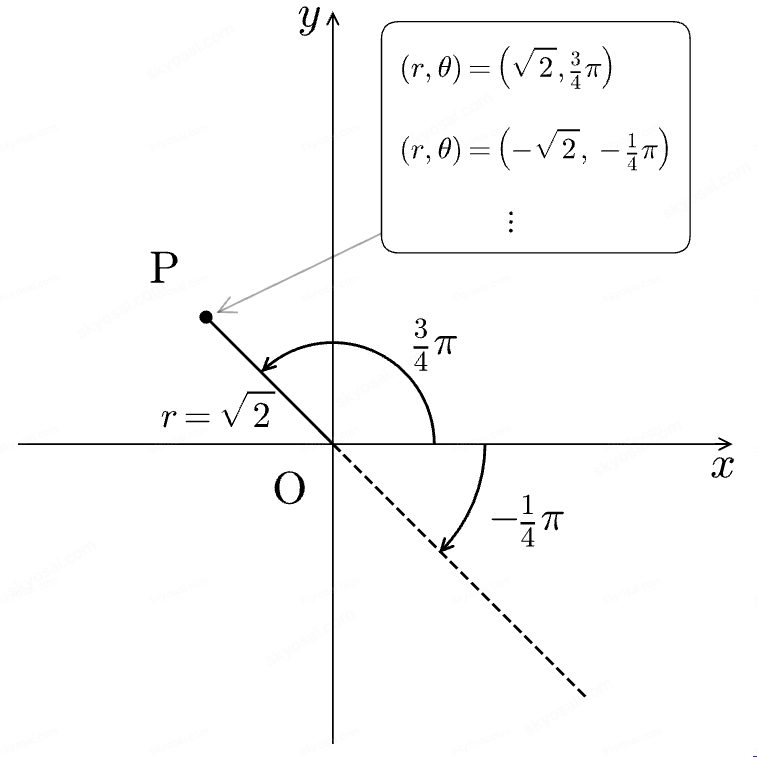
(例) 直交座標で\( \displaystyle (x, y)=(-1, 1) \)と表される点を極座標で表す(原点を極,\( \displaystyle x \)軸の正の部分を始線とする).
・\( \displaystyle r \geqq 0, 0 \leqq \theta \lt 2\pi \)に制限すると,\( \displaystyle (r, \theta)=\left(\sqrt{2}, \frac{3}{4}\pi\right) \).
・一般には,\( \displaystyle (r, \theta)=\left(\sqrt{2}, \frac{3}{4}\pi+2n\pi\right) \ \ (n\text{は整数}), (r, \theta)=\left(-\sqrt{2}, -\frac{1}{4}\pi+2n\pi\right) \ \ (n\text{は整数}) \)とも表せる.
○極方程式
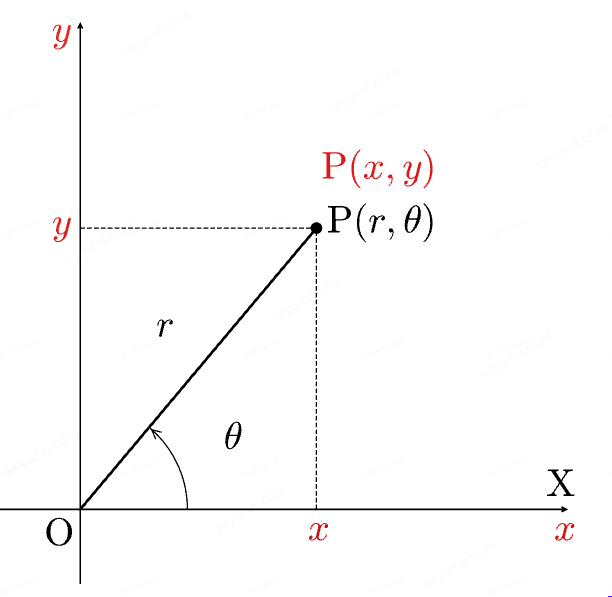
※\( \displaystyle xy \)平面上で,原点を極,\( \displaystyle x \)軸の正の部分を始線とする極座標について,
\( \displaystyle \ \ \ \ \ x^2+y^2=r^2, x=r \cos \theta, y=r \sin \theta \)
が成り立つ.これを利用して,「極方程式」と「直交座標に関する方程式」の変換ができる.
次の極方程式を,直交座標に関する方程式に表し,どのような図形か考察する.
(1) \( \displaystyle 2r \sin\left(\theta+\frac{\pi}{6}\right)=1 \)
(2) \( \displaystyle r=\frac{3}{1+2\cos\theta} \)
この記事は役に立ちましたか?
間違い/不具合かな?
と思ったらこちらへ