○空間ベクトルの成分表示
平面の場合と同様に,\( \displaystyle xyz \)空間上の\( \displaystyle 2 \)点\( \displaystyle \mathrm{O}(0,0,0), \mathrm{A}(a,b,c) \)に対し,\( \displaystyle \overset{\xrightarrow{\quad}}{\mathrm{OA}} \)を\( \displaystyle \begin{pmatrix} a \\ b \\ c \end{pmatrix} \)で表す.
計算方法は平面の場合と同様.
○成分表示での計算
\( \displaystyle \vec{a}=\begin{pmatrix} a \\ b \\ c \end{pmatrix}, \vec{b}=\begin{pmatrix} d \\ e \\ f \end{pmatrix} \),\( \displaystyle k \)を実数とする.
\( \displaystyle (1) \vec{a}+\vec{b}=\begin{pmatrix} a+d \\ b+e \\ c+f \end{pmatrix} \ \ \ \) \( \displaystyle (2) \vec{a}-\vec{b}=\begin{pmatrix} a-d \\ b-e \\ c-f \end{pmatrix} \ \ \ \) \( \displaystyle (3) k\vec{a}=\begin{pmatrix} ka \\ kb \\ kc \end{pmatrix} \ \ \ \) \( \displaystyle (4) |\vec{a}|=\sqrt{a^2+b^2+c^2} \)
\( \displaystyle (5) \vec{a} \cdot \vec{b}=ad+be+cf \)
※いずれも平面座標の場合と同様に導ける.
○直線の方程式(空間座標版)
点\( \displaystyle \mathrm{A}(p,q,r) \)を通り,ベクトル\( \displaystyle \vec{d}=\begin{pmatrix} l \\ m \\ n \end{pmatrix} \)を方向ベクトルにもつ直線上の点\( \displaystyle \mathrm{P}(x,y,z) \)は,
ある実数\( \displaystyle t \)を用いて,\( \displaystyle \overset{\xrightarrow{\quad}}{\mathrm{AP}}=t\vec{d} \ \ \left(\Leftrightarrow \overset{\xrightarrow{\quad}}{\mathrm{OP}}=\overset{\xrightarrow{\quad}}{\mathrm{OA}}+t\vec{d}\right) \)と表される.すなわち,
\( \displaystyle \ \ \ \ \ x=p+lt, y=q+mt, z=r+nt \) (直線の媒介変数表示)
また,\( \displaystyle l,m,n \neq 0 \)のときは,\( \displaystyle t \)を消去することにより,
\( \displaystyle \ \ \ \ \ \frac{x-p}{l}=\frac{y-q}{m}=\frac{z-r}{n} \) (直線の方程式)
(例,新潟県)
\( \displaystyle 2 \)点\( \displaystyle \mathrm{A}(-1,-2,-3), \mathrm{B}(7,4,7) \)を通る直線に,点\( \displaystyle \mathrm{P}(2,-1,4) \)から下ろした垂線の足を\( \displaystyle \mathrm{H} \)とおく.このとき,点\( \displaystyle \mathrm{H} \)の座標を求めよ.
点\( \displaystyle \mathrm{H} \)は直線\( \displaystyle \mathrm{AB} \)上にあるから,実数\( \displaystyle t \)を用いて
\( \displaystyle \overset{\xrightarrow{\quad}}{\mathrm{OH}}=\overset{\xrightarrow{\quad}}{\mathrm{OA}}+t\overset{\xrightarrow{\quad}}{\mathrm{AB}} \)
と表される.よって,
\( \displaystyle \ \ \ \ \ \overset{\xrightarrow{\quad}}{\mathrm{OH}}=\begin{pmatrix} -1 \\ -2 \\ -3 \end{pmatrix}+t\begin{pmatrix} 8 \\ 6 \\ 10 \end{pmatrix}=\begin{pmatrix} -1+8t \\ -2+6t \\ -3+10t \end{pmatrix}, \overset{\xrightarrow{\quad}}{\mathrm{PH}}=\overset{\xrightarrow{\quad}}{\mathrm{OH}}-\overset{\xrightarrow{\quad}}{\mathrm{OP}}=\begin{pmatrix} -3+8t \\ -1+6t \\ -7+10t \end{pmatrix} \)
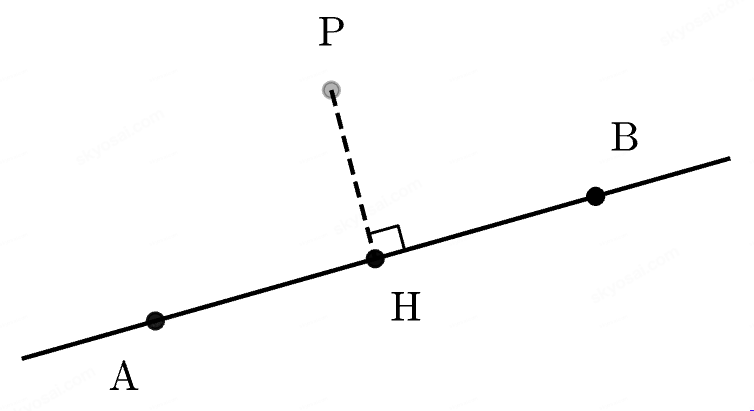
\( \displaystyle \mathrm{PH} \)は直線\( \displaystyle \mathrm{AB} \)と垂直であるから,\( \displaystyle \overset{\xrightarrow{\quad}}{\mathrm{PH}} \cdot \overset{\xrightarrow{\quad}}{\mathrm{AB}}=0 \).
\( \displaystyle \ \ \ \ \ \overset{\xrightarrow{\quad}}{\mathrm{PH}} \cdot \overset{\xrightarrow{\quad}}{\mathrm{AB}}=0 \Leftrightarrow \begin{pmatrix} -3+8t \\ -1+6t \\ -7+10t \end{pmatrix} \cdot \begin{pmatrix} 8 \\ 6 \\ 10 \end{pmatrix}=0 \)
\( \displaystyle \ \ \ \ \ \ \ \ \ \ \ \ \ \ \ \ \ \ \ \ \ \ \ \ \ \ \ \ \ \ \ \ \ \ \ \ \Leftrightarrow 4 \cdot (-3+8t)+3 \cdot (-1+6t)+5 \cdot (-7+10t)=0 \)
\( \displaystyle \ \ \ \ \ \ \ \ \ \ \ \ \ \ \ \ \ \ \ \ \ \ \ \ \ \ \ \ \ \ \ \ \ \ \ \ \Leftrightarrow 100t-50=0 \Leftrightarrow t=\frac{1}{2} \)
よって,
\( \displaystyle \ \ \ \ \ \overset{\xrightarrow{\quad}}{\mathrm{OH}}=\begin{pmatrix} 3 \\ 1 \\ 2 \end{pmatrix} \ \ \ \ \ \therefore \mathrm{H} \)の座標は\( \displaystyle (3,1,2) \) (答)
○外積と平面の方程式
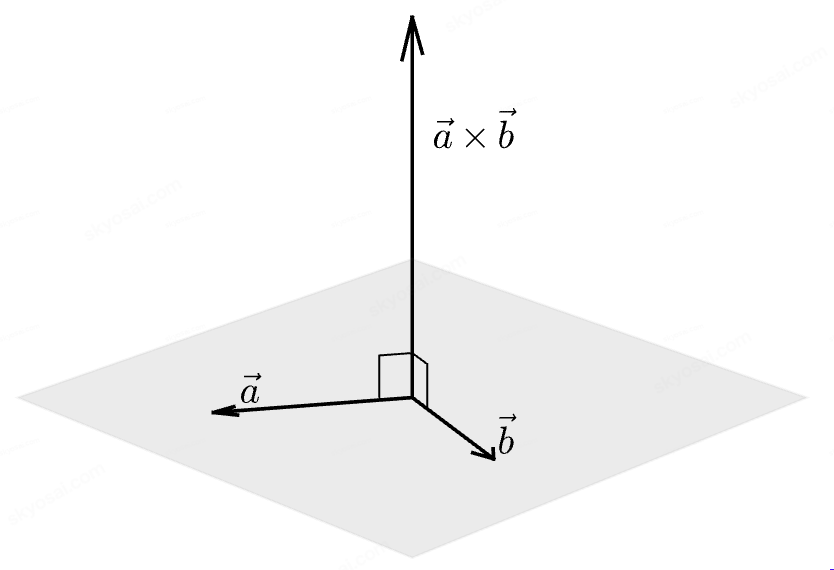
(1) \( \displaystyle \vec{a}=\begin{pmatrix} a_1 \\ a_2 \\ a_3 \end{pmatrix}, \vec{b}=\begin{pmatrix} b_1 \\ b_2 \\ b_3 \end{pmatrix} \)に対し,ベクトル\( \displaystyle \begin{pmatrix} a_2 b_3-a_3 b_2 \\ a_3 b_1-a_1 b_3 \\ a_1 b_2-a_2 b_1 \end{pmatrix} \)を,\( \displaystyle \begin{pmatrix} a_1 \\ a_2 \\ a_3 \end{pmatrix}, \begin{pmatrix} b_1 \\ b_2 \\ b_3 \end{pmatrix} \)の外積といい,\( \displaystyle \vec{a} \times \vec{b} \)で表す.
(2) \( \displaystyle \vec{a} \cdot (\vec{a} \times \vec{b})=0, \vec{b} \cdot (\vec{a} \times \vec{b})=0 \ \ (\to \vec{a} \times \vec{b} \neq \vec{0} \)のとき,\( \displaystyle \vec{a} \times \vec{b} \)は,\( \displaystyle \vec{a}, \vec{b} \)とそれぞれ垂直である)
(3) 点\( \displaystyle \mathrm{A}(p,q,r) \)を通り,ベクトル\( \displaystyle \vec{n}=\begin{pmatrix} a \\ b \\ c \end{pmatrix} \)を法線ベクトルにもつ平面上の点\( \displaystyle \mathrm{P}(x,y,z) \)は,
\( \displaystyle \ \ \ \ \ \overset{\xrightarrow{\quad}}{\mathrm{AP}} \cdot \vec{n}=0 \ \ \left(\Leftrightarrow \left(\overset{\xrightarrow{\quad}}{\mathrm{OP}}-\overset{\xrightarrow{\quad}}{\mathrm{OA}}\right) \cdot \vec{n}=0\right) \)を満たす.すなわち,\( \displaystyle a(x-p)+b(y-q)+c(z-r)=0 \) (平面の方程式)
○内積と外積
空間ベクトル\( \displaystyle \vec{a}, \vec{b} \)に対し,\( \displaystyle \vec{a}, \vec{b} \)のなす角を\( \displaystyle \theta \ (0 \leqq \theta \leqq \pi) \)とするとき,
(1) \( \displaystyle \vec{a} \cdot \vec{b}=|\vec{a}||\vec{b}|\cos\theta \) (内積の定義.平面ベクトルの場合と同様)
(2) \( \displaystyle |\vec{a} \times \vec{b}|=|\vec{a}||\vec{b}|\sin\theta \)
((2)の説明)
\( \displaystyle \vec{a}=\begin{pmatrix} a_1 \\ a_2 \\ a_3 \end{pmatrix}, \vec{b}=\begin{pmatrix} b_1 \\ b_2 \\ b_3 \end{pmatrix} \)とする.
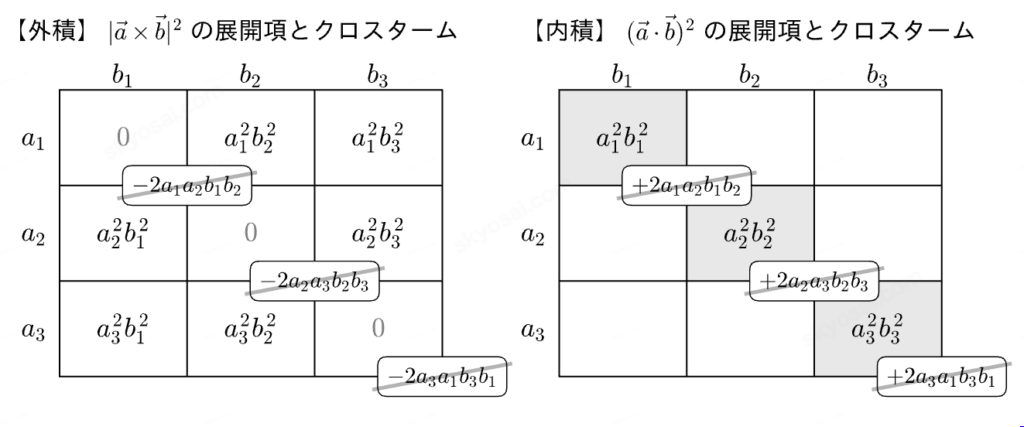
\( \displaystyle |\vec{a} \times \vec{b}|^2+(\vec{a} \cdot \vec{b})^2 \)
\( \displaystyle \ \ \ \ \ =(a_2 b_3-a_3 b_2)^2+(a_3 b_1-a_1 b_3)^2+(a_1 b_2-a_2 b_1)^2+(a_1 b_1+a_2 b_2+a_3 b_3)^2 \)
\( \displaystyle \ \ \ \ \ =(a_2^2 b_3^2-2a_2 a_3 b_2 b_3+a_3^2 b_2^2)+(a_3^2 b_1^2-2a_1 a_3 b_1 b_3+a_1^2 b_3^2)+(a_1^2 b_2^2-2a_1 a_2 b_1 b_2+a_2^2 b_1^2) \)
\( \displaystyle \ \ \ \ \ \ \ \ \ \ \ \ \ \ \ \ +(a_1^2 b_1^2+a_2^2 b_2^2+a_3^2 b_3^2+2a_1 a_2 b_1 b_2+2a_2 a_3 b_2 b_3+2a_3 a_1 b_3 b_1) \)
\( \displaystyle \ \ \ \ \ =a_1^2 b_1^2+a_1^2 b_2^2+a_1^2 b_3^2+a_2^2 b_1^2+a_2^2 b_2^2+a_2^2 b_3^2+a_3^2 b_1^2+a_3^2 b_2^2+a_3^2 b_3^2 \)
\( \displaystyle \ \ \ \ \ =(a_1^2+a_2^2+a_3^2)(b_1^2+b_2^2+b_3^2)=|\vec{a}|^2 |\vec{b}|^2 \)
よって,\( \displaystyle |\vec{a} \times \vec{b}|^2=|\vec{a}|^2 |\vec{b}|^2-|\vec{a}|^2 |\vec{b}|^2 \cos^2\theta=(|\vec{a}||\vec{b}|\sin\theta)^2 \)の両辺の平方根をとって成立.
○点と平面の距離・球面の方程式
(1) 点\( \displaystyle \mathrm{A}(X,Y,Z) \)と平面\( \displaystyle ax+by+cz+d=0 \)の距離は
\( \displaystyle \ \ \ \ \ \frac{|aX+bY+cZ+d|}{\sqrt{a^2+b^2+c^2}} \)
(2) 点\( \displaystyle \mathrm{A}(a,b,c) \)を中心とする半径\( \displaystyle r \)の球面の方程式は,
\( \displaystyle \ \ \ \ \ (x-a)^2+(y-b)^2+(z-c)^2=r^2 \)
(例,沖縄県改題)
\( \displaystyle 4 \)点\( \displaystyle \mathrm{A}(2,0,0), \mathrm{B}(0,2,0), \mathrm{C}(0,0,4), \mathrm{D}(2,4,6) \)があるとき,
(1) \( \displaystyle \triangle \mathrm{ABC} \)の面積を,公式を用いて求める.
(2) 平面\( \displaystyle \mathrm{ABC} \)の方程式を外積を利用して求める.
(3) 四面体\( \displaystyle \mathrm{ABCD} \)の体積について,点と平面の距離公式を利用して求める.
この記事は役に立ちましたか?
間違い/不具合かな?
と思ったらこちらへ